| Chronological disease
progression and each downstream factor |
| ,, |
|
|
| |
| |
| |
 |
| |
|
|
Normal Brain vs Austic
Brain
Overview of how each factor
impacts Neonatal Brain
development |
| |
Normal
Brain Development
Mother
maintains optimal serum 25(OH)D levels -- > Neonatal VDR's
optimize Mitochondrial function and fetus/neural
development----->
Proper mitochondrial function prevents ATP release and
downstream
P2Y2 receptor/mTOR signaling ----->
preventing up
regulation of the mTOR pathway/HIF-1α
due to oxidative stress ----> proper
Autophagy expression(pruning)
prevents excessive synapses overgrowth -----> resulting in
the orderly degradation & elimination of intracellular
organelles,
damaged mitochondria & other components that must be
recycled in order to maintain neuron/cellular homeostasis ----->
|
Optimal serum
25(OH)D levels
Proper Synapses Pruning - Normal
Brain Development |
Low
serum 25(OH)D levels -
Neuroinflammation
Synapses Overgrowth - Enlarged Brain |
| |
|
|
Autistic
Brain Development
Deficient
neonatal
25(OH)D levels ---- > VDR can not
optimize mitochondrial function ----->
intracellular oxidative stress begins to accumulate ----->
initiates mitochondrial
ATP/H202 release into cytoplasm due to mitochondrial
dysfunction----->
activation of
P2Y2 receptors promotes mTOR signaling -----> mTOR pathway
is activated ----->
Oxidative Stress increases---->
HIF-1α expression is up
regulated ----->
Autophagy is blocked (deficient synapses pruning) ----->
results in Synapses overgrowth ------>
Brain inflammation
-----> Onset of Autistic features and behaviors ----->
Brain
overgrowth/enlargement |
|
| |
| |
*
Large
amounts
of
overactive mTOR
were found in
almost all of the
brains of the autism patients |
|
View this
Report here |
| |
| |
.
Activated 1,25(OH)2D3
regulates
all chores & tasks
Optimal serum levels dictate
neurodevelopment & protect neurons from autistic triggers
. |
| |
|
.Autism Disease Progression Analogy
"The Mother of the household"
1,25(OH)2D3
|
|
|
VDR
Can't transcribe
900+ genes without activated 1,25(OH)D
|
Mitochondria
Without proper VDR
transcription, Mitochondria
fail to produce optimal
Energy/ATP/Oxygen levels
|
Oxidative Stress
Cell
experiences stress which forces the cell to
initiate antioxidant
responses
|
ATP release
First to notify everyone there
is an oxygen problem
|
PY2Y Receptor
purinergic signalling
initiates stress response
PY2Y
asks mTOR for help
|
mTOR
Shuts down autophagy which causes
HIF-1 and oxidative
stress levels to increase
|
HIF-1
Due to extreme levels of
oxidative stress, HIF-1
turns off
Mitochondria &
ATP production
|
|
Child #1 |
Child #2 |
Child #3 |
Child #4 |
Child #5 |
Child #6 |
Child # 7 |
|
Per mother's orders,
Oldest child oversees activities of each child
during chores.
MESSENGER
Nuerons are loaded with VDR's which can not tell
the cell what to do without active Vit D.
|
If this child fails to do their chore, all of
the other kids will quit performing their
chores.
TOO LETHARGIC
Mitochondrial dysfunction leads to impaired ATP
production and diminished cellular respiration.
|
Child #3 sees #2 has stopped working & responds
by yelling at #2 to get back to work or she is
going to tell the others.
THE BRINK OF CHAOS
If mitochondrial dysfunction persists, oxidative
stress
begins to accumulate.
|
#4 finds out that #2 & #3 have quit working, and
runs outside to tell #5 that no one is doing
their chores.
CHAOS STARTS
Oxidative stress reaches levels where
mitochondrial ATP are released into the cytoplasm
as a stress signal.
|
#5 runs through the house messing up all of the
work that had already been performed.
ALTERED TRANSCRIPTION
Stress genes are activated in response to
oxidative stress and ATP release. Normal gene
transcription is altered.
|
#6 sees what #5 is doing and takes all of the
mops/brooms & the vacuum cleaner & hides them
in the closet.
AUTOPHAGY BLOCKED
As a survival mechanism, "stressed cell" genes
are transcribed which leads to autophagy
deregulation.
|
To block anyone from doing their chores,
#7 decides to turn off
all the power in the house.
NO
ELECTRICITY
HIF-1 shuts down mitochondria & ATP production.
Hypoxic genes transcribed. Normoxic genes turned
off.
|
| |
|
|
|
|
|
|
|
| |
|
|
| |
|
|
.
KEY
ANALOG COMPOUNDS
1,25(OH)2D3
& Cannabidiol
Combination of both compounds
will provide optimal differentiation
of mitotic blasts via VDR & CB1 receptor activation
. |
|
|
|
PLoS One. 2013; 8(1): e54271.
Type-1 (CB1) Cannabinoid Receptor
Promotes
Neuronal Differentiation and Maturation of Neural Stem Cells
Claudia Compagnucci,1,2 Sara Di Siena,1 Maria Blaire Bustamante,1,2
|
|
|
|
Abstract
.
Neural stem cells (NSCs) are self-renewing cells that can
differentiate into multiple neural lineages and repopulate regions
of the brain after injury. We have investigated the role of
endocannabinoids (eCBs), endogenous cues
that modulate neuronal functions including neurogenesis, and their
receptors CB1 and CB2
in mouse NSCs. Real-time PCR and Western blot analyses indicated
that CB1 is present at higher levels than CB2 in NSCs.
.
The eCB anandamide (AEA) or the
CB1-specific agonist ACEA enhanced
NSC differentiation into neurons,
but
not astrocytes
and
oligodendrocytes, whereas the CB2-specific
agonist JWH133 was ineffective. Conversely, the effect of AEA was
inhibited by CB1, but not CB2, antagonist,
corroborating the specificity of the
response.
.
CB1 activation also enhanced
maturation of neurons, as
indicated by morphometric analysis of neurites. CB1 stimulation
caused long-term inhibition of the ERK1/2 pathway. Consistently,
pharmacological inhibition of the ERK1/2 pathway recapitulated the
effects exerted by CB1 activation on neuronal differentiation and
maturation. Lastly, gene array profiling showed that
CB1 activation augmented the
expression of genes involved in neuronal differentiation
while decreasing that of stemness genes.
.
These results
highlight the
role of CB1 in the regulation of NSC
fate
and suggest that its
activation may represent a
pro-neuronal differentiation
signal.
|
|
| |
| |
| |
|
https://www.ncbi.nlm.nih.gov/pubmed/25681066 |
| |
|
Exp Mol Pathol. 2015 Apr
1,25-Dihydroxyvitamin
D3 enhances neural stem cell
proliferation and oligodendrocyte
differentiation
Abstract
1,25-Dihydroxyvitamin D3
(1,25(OH)2D3) has recently been found to
suppress experimental autoimmune
encephalomyelitis (EAE), an animal model of
multiple sclerosis (MS). Although its effect
was attributed to an anti-inflammatory
mechanism, it is not clear whether this
treatment can also directly act on neural
cells to promote CNS recovery.
The present study
investigates the effect of various
concentrations of 1,25(OH)2D3 on
neural stem
cell (NSC) proliferation and
their
differentiation to oligodendrocytes,
the myelinating cells. We have, for the
first time, shown that
NSCs
constitutively express vitamin D receptor
(VDR), which can be upregulated
by 1,25(OH)2D3. This vitamin
significantly enhanced proliferation
of NSCs, and enhanced their differentiation into
neurons and
oligodendrocytes, but
not astrocytes.
NSCs treated with
1,25(OH)2D3 showed increased expression of
NT-3, BDNF, GDNF and CNTF,
important
neurotrophic factors for neural cell
survival and
differentiation.
Overall, we demonstrated
that 1,25(OH)2D3 has a direct effect
on NSC proliferation, survival, and neuron/oligodendrocyte
differentiation, thus
representing a novel mechanism underlying
its remyelinating and neuroprotective effect
in MS/EAE therapy.
|
| |
.
CBD
NEEDS HELP!
For complete
NEURONAL DIFFERENTIATION,
CBD needs to be
administered
with activated 1 alpha,25-dihydroxycholecalciferol |
|
|
|
| |
| |
|
|
|
| |
|
Proc Natl Acad Sci U S A. 1987
Aug;84(15):5414-8.
Cannabinoids induce
incomplete maturation
of cultured human leukemia
cells.
Murison G, Chubb CB, Maeda S, Gemmell MA,
Huberman E.
|
| |
|
Abstract
Monocyte
maturation markers were induced in cultured
human myeloblastic ML-2 leukemia cells after
treatment for 1-6 days with 0.03-30 microM delta
9-tetrahydrocannabinol (THC), the major
psychoactive component of marijuana. After a
2-day or longer treatment,
2- to 5-fold
increases were found in the percentages of cells
exhibiting reactivity with
either the murine OKM1 monoclonal antibody or
the Leu-M5 monoclonal antibody, staining
positively for nonspecific esterase activity,
and displaying a promonocyte morphology.
The
increases in
these differentiation markers after treatment
with 0.03-1 microM THC were dose dependent.
At this dose range, THC did not cause an
inhibition of cell growth. The THC-induced cell
maturation was also characterized by specific
changes in the patterns of newly synthesized
proteins.
Pronounced among
these changes was an increase in the synthesis of at least
10 proteins that are found abundantly in
monocytes. The
THC-induced differentiation did not,
however, result in cells with a highly developed
mature monocyte phenotype; the
THC-treated cells failed to exhibit other
monocyte markers such as attachment to the
surface of tissue culture dishes or
morphological maturation beyond the promonocyte
stage.
However,
treatment of
these "incompletely" matured cells
with either phorbol 12-myristate 13-acetate or
1
alpha,25-dihydroxycholecalciferol,
which are
inducers of differentiation in myeloid leukemia
cells
(including ML-2 cells),
produced cells
with a mature monocyte morphology.
Two other
cannabinoids, cannabidiol and cannabinol,
which were more
cytotoxic than THC at comparable
doses, also caused an increase in the expression of
maturation markers, but
at
doses higher
than those required for THC.
The ML-2 cell
system described here may be a useful tool for
deciphering critical biochemical events that
lead to the
cannabinoid-induced "incomplete" cell
differentiation of ML-2 cells
and other related cell types.
Findings obtained from this system may have
important implications for studies of
cannabinoid
effects on normal human bone-marrow progenitor
cells.
|
| |
|
Read more CBD clinical studies |
| |
| |
.
CBD PATIENT
TESTIMONIAL
Young autistic boy Speaks for
the first time after CBD use
. |
|
| |
|
Controversial Cannabis
Treatment Helps 9-Year-Old Boy
Speak His First Words
Beth Greenfield -
Senior Writer
June 3, 2015
|
| |
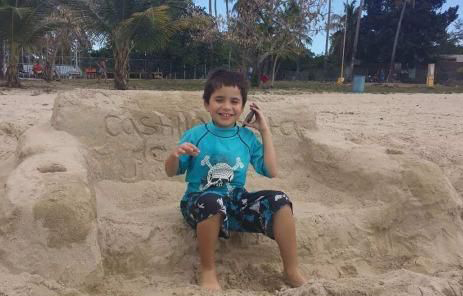 |
Kalel Santiago, 9, who has
autism, spoke his first words
shortly after starting hemp-oil
treatments. (Photo: Santiago
family)
Though Kalel Santiago of Puerto
Rico is only 9 years old, he’s
already endured some adult-level
struggles. At just 10 months,
he was diagnosed with the rare
childhood cancer neuroblastoma,
and spent more than two years
undergoing surgery,
chemotherapy, and radiation
treatments. Then came the next
diagnosis: severe, non-verbal
autism.
“While he was in the
hospital, we noticed he didn’t
speak at all and had some
behavior that wasn’t right, like
hand flapping, and walking on
his toes,” his father,
Abiel Gomez Santiago, tells
Yahoo Parenting from the
family’s home in Aguada. “But
we waited until he was 3 and
cancer-free to look at his
behavior.”
|
|
| |
|
|
He and his wife Gladys — also
parents to two older boys, now
18 and 20 — did a cram course in
educating themselves on autism.
They tried various schools and
therapies, and eventually found
impressive success with a unique
surf-therapy school near their
home. Then, through an April
fundraising event for that
program, the Santiagos
happened upon a treatment that
would quickly change their lives:
hemp oil, rich in the compound
cannabidiol (CBD),
which has been shown, at least
anecdotally, to
dramatically ease symptoms of
both epilepsy and autism.
They took home the tiny sample
bottle of spray and
began giving their son twice
daily doses, as
directed on the label,
right into his mouth.
And the results, they say, were
startling:
Kalel started talking — in just
two days.
“He surprised us in school by
saying the vowels, A-E-I-O-U. It
was the first time ever,”
Abiel says. “You can’t
imagine the emotion we had,
hearing Kalel’s voice for the
first time. It was amazing.
The teacher recorded him and
sent it to my wife and me and we
said well,
the only different thing we have
been doing is using the CBD.”
Soon thereafter, he adds, Kalel
started using consonants to
connect his sounds.
“He said, ‘amo mi mama,’ ‘I love
my mom,’” Abiel
says. “I don’t know how
to thank [the CBD oil makers........
|
|
| |
| |
| |
.
PHARMACEUTICAL CBD
CLINICAL STUDIES
Stock value increases 40% in
30 days
. |
|
| |
 |
London based GW
Pharmaceuticals Stock Value
Increase 40% due to Cannabis Drug
Milestones
APR 27, 2015
@ 02:25 PM |
| |
|
Company has
announced the initiation of
study trials, received
Orphan Drug Status to use
cannabidiol on newborn babies
and gotten a Notice of
Allowance for a patent
application for treating
epilepsy with another
of its cannabis based compounds.
They are focused on
researching, developing and then
commercializing treatments from
its cannabinoid products
derived from the cannabis or
marijuana plant.
On April 21st,
the company announced it was
initiating its second
Phase 3 clinical trial of its
signature drug Epidiolex for the
treatment of Dravet syndrome,
which is a rare form of
childhood epilepsy and
tends to be treatment resistant.
“The
start of our second pivotal
Phase 3 clinical trial for
Epidiolex in the treatment of
Dravet syndrome marks another
key milestone in our plan to
submit a New Drug Application
for Epidiolex to the FDA in
mid-2016,” stated
Justin Glover, CEO of GW
Pharmaceuticals. GW also
said it expects to initiate two
more Phase 3 studies using the
drug for Lennox-Gastaut
syndrome, another form of
epilepsy that rears its ugly
head when a child is between the
ages of two and six. A
recent report from doctors using
GW’s drug showed that 11 LGS
patients saw their seizures drop
by 55% at the end of 12 weeks.
But it
doesn’t work for all patients as 14
dropped out from treatment when
there was no effect. GW is
also looking at even more
illnesses that Epidiolex can
help including
Tuberous Sclerosis Complex. TBS
is a genetic disorder that
causes multiple tumors and
75-90% of the patients
experience seizures.
Then on April
24th, GW announced that it got
an Orphan Drug Designation from
the FDA to use Cannabidiol (CBD)
to treat babies that suffer
brain injuries when they are
deprived of oxygen during the
birthing process.
It’s called neonatal
hypoxic-ischemic encephalopathy
and it happens in 1.5 to 2.8 per
1,000 births a year. GW
developed an intravenous
form of CBD and expects
to submit an Investigational New
Drug Application to the FDA in
mid 2015 and start a Phase 1
study in the second half of the
year. “This orphan drug
designation for cannabidiol for
the treatment of newborn
children with neonatal
hypoxic-ischemic encephalopathy
follows several years of
pre-clinical evaluation and we
look forward to advancing a
clinical development program in
this important medical condition
this year,” said Glover.
Then finally on
Monday April 27th, GW
announced that the U.S. Patent
Office issued a Notice of
Allowance for a patent
application to cover the use of
Cannabidivarin (CBDV) to treat
epilepsy. There are
85
differently identified cannabinoids in the cannabis
plant and
CBDV
has a slightly different
molecular structure.
For all the science wonks out
there Mark Rogerson of GW said,
“CBDV
has its side-chain
shortened by two methylene
bridges (CH2 units).”
All of these
announcements has
continued to push the stock
higher. It has
increased by 40% in
the past month
alone. There are only six
analysts covering the
company according to Thomson
One Analytics and four
according to Yahoo YHOO
+0.00%! Finance all with a
Buy rating.
.
If the company
continues getting strong
positive results from these
studies, the stock will
continue to move higher.
Even if some patients aren’t
helped, the ones the drugs
do work on are patients that
were getting no relief from
any other treatments. A win
win.........Read
Full Article
|
|
|
|
|
|
|